Key takeaways
- OT networks are not instrumented for detection by default: passive monitoring must be deployed before a pentest runs.
- Protocol-level anomalies, including unexpected Modbus writes and EtherNet/IP sessions from new hosts, are the primary detection signal in the control network.
- Zone crossings from the IT network into the OT DMZ and from there to the control layer are where most ICS attacks succeed without alerting.
- Every observation the pentest team makes that your monitoring missed is a gap that should become a detection rule before the report is closed.
- Turning pentest findings into production alert rules requires a purple team follow-up, not just a remediation ticket.
The visibility gap most OT networks carry into a pentest
An OT/ICS pentest opens on a network built for deterministic control, not observability. Legacy PLCs and RTUs generate no logs. HMIs run unpatched operating system versions that predate modern EDR. Historians sit on isolated subnets with no forwarding rule to any SIEM. Most security teams have near-zero visibility into the live operational network.
That gap is not a reason to delay the pentest. It is the first finding. A test run while your monitoring is blind shows exactly what an attacker could do without triggering a single alert. For each technique the pentest uses, your security team needs to know whether anything fired, and if nothing did, what would need to change.
Enterprise (L4-5)
SIEM and EDR
IT logs, endpoint telemetry, threat feeds
Firewall logs
North-south traffic, internet ingress
OT DMZ (L3.5)
Network IDS
Passive tap on historian and jump-server traffic
Zone boundary logs
Firewall rules between IT and OT segments
Control and Field
Passive protocol monitor
Modbus, DNP3, EtherNet/IP, OPC-UA parsing
No field-level telemetry
PLCs and RTUs produce no security events
Why passive monitoring is the only safe approach in the control network
Active scanning in an OT network is not safe. Many PLCs and RTUs respond to unexpected traffic by entering a fault state, and a single ICMP sweep to the wrong address can interrupt a running process. That is what separates an infrastructure pentest from an ICS engagement: the pentest team uses passive techniques in the control network, and your monitoring must do the same.
A passive tap on the OT DMZ switch and a span port on the main OT LAN segment cover most of what the pentest team will do. From those two positions, a passive sensor running Zeek or a purpose-built OT protocol parser can reconstruct every session, parse every Modbus transaction and flag every new host on the segment. Deploy both before day one, or the monitoring question cannot be answered.
Asset inventory is a secondary benefit of passive monitoring, but a real one. Many OT asset registers are out of date. The pentest team will find devices nobody knew were on the network, and your monitoring platform will too. A device absent from the asset register that begins communicating on EtherNet/IP is both a pentest finding and a standing detection gap.
Protocol-level anomalies: what to look for and why they matter
The control network carries a small, predictable set of protocols. Modbus TCP, DNP3, EtherNet/IP, OPC-UA and PROFINET cover most industrial environments, and within each, normal traffic follows strict patterns. A SCADA master polls the same PLC coils at the same interval. A historian queries the same OPC-UA tags. An HMI reads the same registers. Any deviation is the signal your monitoring should act on.
MITRE ATT&CK for ICS documents the techniques a pentest team and a real attacker use. Most produce protocol-level anomalies: an unexpected write to a coil or register, a function code the SCADA master never sends, a new source IP in an EtherNet/IP session. None of those are hard to detect. They require a parser that understands the protocol and a baseline of what normal looks like. Without the baseline, every write looks identical, and the one the pentest team issued to show impact is invisible.
| Protocol | Normal pattern | Anomaly to detect | ATT&CK for ICS tactic |
|---|---|---|---|
| Modbus TCP | SCADA master reads coils at fixed interval | Write coil from unexpected source IP or to out-of-range address | Impair Process Control (T0806) |
| DNP3 | RTU sends event data to control centre on schedule | Unsolicited response directed to a new destination IP | Collection (T0802) |
| EtherNet/IP | HMI reads controller tags over CIP on fixed schedule | Explicit message session from host outside the control network | Lateral Movement |
| OPC-UA | Historian queries tag server on a fixed session | New session established from a non-historian IP address | Collection (T0801) |
| PROFINET | Controller cyclic data exchange with I/O device | Acyclic write to I/O device from engineering host outside maintenance window | Impair Process Control |
Zone crossings: detecting the move from IT into the OT network
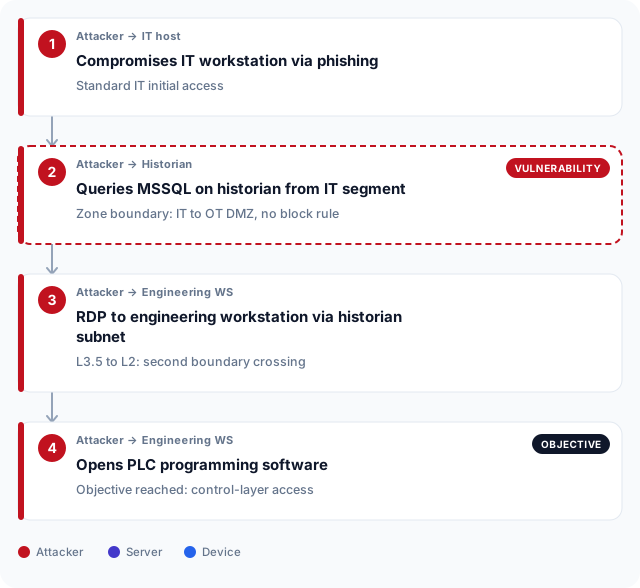
The path from a compromised IT workstation into the OT network runs through the DMZ. The historian is the most common stepping stone: it holds a database connection to the SCADA tier and an MSSQL port open to the IT segment. From there, a jump server or an RDP session gives access to an engineering workstation and from there to the HMI. None of those steps use OT-specific protocols. They run over standard IT protocols your existing monitoring can see.
Watch for a new source IP querying the historian database, an RDP session from the historian subnet, and an engineering workstation opening PLC programming software outside a maintenance window. The sequence is the signal. No single step is conclusive, but a new IP reaching the historian followed by an RDP session to an engineering workstation within the same hour is a chain your SIEM can detect today, without OT-specific tooling.
This is why the boundary between your IT and OT monitoring matters. An assumed-breach engagement starting from a corporate workstation will cross your firewall, appear in the historian's access logs and use RDP. If those three sources are not correlated, the chain is invisible. The pentest is the controlled test that shows whether the correlation rule exists or needs to be written.
Turning pentest observations into detection rules that stay working
Every technique the pentest team used that produced no alert is a gap. The gap is only closed when a detection rule exists, has been tested against a real replay of the technique and has an owner. A finding noting that no alert fired on a coil write from an unexpected source is useful. A production Modbus write detection rule that fires on the next test and is assigned to an engineer is the actual deliverable.
That translation happens in a purple team follow-up. The pentest team replays each technique while the blue team watches the monitoring platform and tunes the rule until it fires reliably. In OT environments this matters more than in IT: the low-change-rate baseline means a well-tuned rule has almost no false positives once deployed. The signal is real. The only question is whether anyone wrote the rule.
A full OT/ICS pentest ends with a list of detection gaps alongside the vulnerability findings. For each gap, the question to answer before the report closes is: what is the specific query, in your SIEM or OT IDS, that would have caught this? NIST SP 800-115 describes this as a core output of a technical assessment. The NIST Cybersecurity Framework treats detection as a function that must improve continuously, not one set once. Both documents apply to OT environments, not only to IT.
OT detection in the UAE: what Abu Dhabi and Dubai operators face
The UAE operates critical infrastructure across energy, water, transport and industrial sectors in Abu Dhabi and Dubai. Many of those assets fall under federal cybersecurity obligations set by the Telecommunications and Digital Government Regulatory Authority through the UAE Information Assurance Regulation. That regulation requires entities operating critical information infrastructure to maintain monitoring and incident detection capabilities. For OT operators, the requirement extends into the control network, not only the enterprise tier.
In Abu Dhabi, ADHICS applies to healthcare facilities operating industrial medical systems. In Dubai, DESC obligations extend to government-connected suppliers running OT environments. Operators in both emirates under CBUAE oversight, including financial institutions running automated payment and settlement infrastructure, face detection requirements that now explicitly reference OT-adjacent systems. None of those regimes use the language of the Purdue Model, but the intent is the same: show that you can see what is happening in your operational network and respond to it.
Many UAE facilities were built before any cybersecurity monitoring requirement existed, and retrofitting passive sensors into a live control network requires change-control processes that can take months. Deploying passive monitoring before the pentest is scheduled is not optional if the engagement is to produce a meaningful detection assessment. An OT/ICS pentest run against an unmonitored network produces a vulnerability list but not the detection maturity evidence a UAE regulator is likely to ask for in the next audit cycle.
Frequently asked questions
What is OT network monitoring, and how does it differ from IT monitoring?
OT network monitoring watches traffic across industrial control system networks, parsing vendor-specific protocols such as Modbus, DNP3 and EtherNet/IP rather than standard IT protocols. Active scanning is unsafe in OT environments: unexpected traffic can cause PLCs to enter a fault state. OT monitoring is therefore passive, reading traffic from a tap or span port rather than querying devices directly.
Can a SIEM detect attacks in an OT network without OT-specific tools?
Partially. Zone boundary crossings, historian database access from unexpected IPs and RDP sessions from the OT DMZ all use standard IT protocols that a SIEM can ingest. Protocol-level anomalies inside the control network, such as unexpected Modbus writes or new EtherNet/IP sessions, require a parser that understands those protocols. A purpose-built OT IDS or passive sensor is needed alongside the SIEM to cover them.
How does an ICS pentest differ from a standard infrastructure pentest?
The main difference is safety. An [infrastructure pentest](/infrastructure-pentest) can use active scanning and exploitation techniques that would be unsafe in an OT environment. An ICS pentest uses passive enumeration in the control network and carefully scoped active techniques, usually limited to the IT and DMZ segments. Availability is the primary constraint: the pentest must not cause a process interruption.
What monitoring should be in place before an OT/ICS pentest runs?
At a minimum: a passive network sensor on the OT DMZ segment and a span port on the main control LAN, both feeding a protocol-aware IDS. Firewall logs for the IT-OT boundary should reach the SIEM. Without those in place, the pentest can find vulnerabilities but cannot answer the detection question, and detection maturity is one of the things the engagement tests.
What MITRE ATT&CK for ICS tactics should OT monitoring target first?
Initial Access, Lateral Movement and Impair Process Control are the highest-priority tactics to detect. Initial Access covers the path from the IT network into the OT DMZ. Lateral Movement covers the move from the DMZ to the control network. Impair Process Control covers techniques that affect process output, such as coil writes and tag modifications. All three produce observable signals in network traffic.
Should the pentest team have access to the monitoring platform during the engagement?
It depends on the objective. If the goal is to test detection coverage, the blue team should monitor independently and the pentest team should not see what is alerting. If the goal is to build detection content, a joint session where both teams watch the same console during replays is more efficient. Both are valid; the scope document should specify which.
How does OT monitoring differ from IoT monitoring?
OT monitoring targets industrial control protocols under a strict safety requirement: no monitoring activity may affect process uptime. [IoT monitoring](/iot-pentest) covers a wider range of consumer and enterprise device protocols and does not carry the same constraint. The Purdue Model zone structure is specific to OT environments. IoT device estates are typically flat networks without equivalent zone enforcement.
What happens when a pentest finding has no corresponding detection rule?
The finding stays open until a rule is written and verified. A vulnerability finding is closed when a retest confirms the patch. A detection gap is only closed when the rule exists, fires correctly on a replay of the technique and has an owner. Detection gaps most often persist after a pentest because the remediation workflow treats them the same as vulnerabilities, closing them on paper without producing a working alert.