
Key takeaways
- A social engineering report must serve three separate readers: leadership, the security team and any auditor reviewing the engagement.
- Each attempt should be documented with a consistent record covering channel, pretext, targeting population, outcome and evidence reference.
- Susceptibility metrics should be broken down by channel and pretext category, not reported as a single aggregate figure.
- Every finding must carry a remediation owner, an action type and a retest plan before the report is considered closed.
- Evidence should be retained for regulatory review purposes, but personal data about named individuals should not circulate in the main report body.
Why a social engineering report is not a technical finding list
A social engineering test report cannot be structured as a list of CVEs with CVSS scores. The finding is behavioural: a staff member was persuaded to open an attachment, hand over credentials or allow physical access. The question the report must answer is not which software is vulnerable, but which controls failed and under what conditions.
This distinction shapes every section of the document. Technical pentest reports read top to bottom: exploited service, root cause, patch. A social engineering report must show the scenario that was run, the response from each targeted population, and what the response means for the organisation's control posture. The scope agreed before a social engineering test defines the variables the report then measures against. If the scope specified phone pretexts and email, the report shows how each channel performed independently.
Readers arrive from three directions. Leadership wants a risk rating and a priority action list. The security or HR team wants to know which groups were targeted and what they did. An auditor wants evidence that the test was authorised, run within scope, and that findings have been assigned to owners. The article on scoping pretexts and channels covers how the scope document creates the baseline the report then measures against. One document must serve all three readers, which is why the structure described below separates the executive summary from the technical findings and from the evidence appendix.
What the executive summary must cover
The executive summary is one to two pages. It states the test's authorised scope, the period it ran, the number of attempts made and an overall susceptibility figure: the percentage of targeted individuals who completed the attacker's intended action. No target names appear here. Roles or departments are acceptable; individuals are not, because the purpose of the report is to improve controls, not to document who failed.
The summary must include a risk rating and the top two or three findings that drive it. Each finding names the channel, the scenario type and the outcome: a vishing call, an account verification pretext, a credential disclosure. These three facts give a summary reading its meaning without disclosing any individual's behaviour to everyone in the room.
The order of content in the summary matters. A reader who stops after the first page should still carry away the risk verdict and the priority actions. Everything that supports those belongs in the layers below, available to whoever needs the depth.
Test scope and authorisation
Dates, channels, targeting population and written authority
Overall risk verdict
Single rating with the factors that drive it
Top findings
Channel and outcome per finding, no individual names
Priority actions
Owner, action type and target date per finding
Supporting data
Pointers to metrics, attempt records and evidence appendix
Documenting each attempt: the minimum record
Each attempt is documented in a consistent record. The minimum fields are: attempt identifier, date and time, channel, pretext used, targeting population (role or department, not individual name), outcome (no response, partial response or completed action), evidence reference and tester initials. Partial responses are recorded separately from completed ones. A user who typed credentials but abandoned the page before submitting is closer to a success than the aggregate numbers show, and the distinction matters for training design.
Pretexts fall into two broad categories: standard impersonations (IT helpdesk, parcel delivery, HR reset) and constructed scenarios built from open-source intelligence about the specific organisation. Record which applies. The OAuth device code phishing article illustrates how a constructed scenario targeting a specific workflow looks different from a generic credential harvesting page. That difference belongs in the finding record because it changes the remediation path: a generic pretext calls for general awareness training; a targeted one points toward an OSINT exposure problem that training alone cannot close.
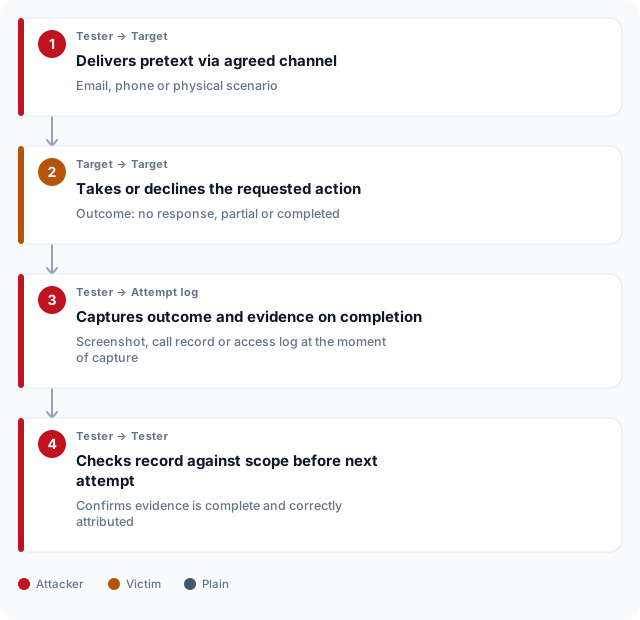
The sequence below shows how a single attempt flows from execution to a documented record. The evidence capture step is the moment that matters. A screenshot taken at the moment of credential entry carries evidential weight; a tester's written reconstruction several days later does not.
Scoring and metrics: what to measure and how to present it
Scoring serves two purposes. First, it gives leadership a comparable figure across test cycles: a susceptibility rate this year against one from a previous cycle is a signal about whether controls are improving. Second, it lets the reporting team identify which variables drove the result, so remediation targets the right layer. An aggregate click rate across all channels and all pretexts in a single number is not useful: it blends very different populations and scenarios into a figure that cannot support a decision.
The breakdown should cover at least three dimensions: channel, pretext category and targeting population. Channel performance varies because of how staff in different workflows handle inbound contact. The article on detection evidence per channel covers what the monitoring side sees during a test, which complements the scoring picture. NIST SP 800-115 sets the standard for evidence quality in technical security testing; the same rigour applies here, meaning metrics must derive from recorded outcomes, not from recollection.
The table below shows the four reporting dimensions for the most common channels, the primary metric for each, the secondary metric and the typical remediation path each finding points toward. Presenting this structure in the report rather than a free-form narrative makes it easier for the fixing team to match findings to owners.
| Channel | Primary metric | Secondary metric | Typical remediation path |
|---|---|---|---|
| Email phishing | Click rate | Credential submission rate | Mail gateway controls and security awareness training |
| Vishing | Completion rate | Sensitive disclosure rate | Call handling process and verbal verification protocol |
| Physical access | Entry success rate | Staff challenge rate | Physical access controls and door and reception procedure |
| Spear phishing | Targeted success rate | OSINT exposure indicators | Attack surface reduction and role-based training |
Remediation section: findings that have owners and dates
Remediation for social engineering findings falls into three categories: awareness training for populations that showed high susceptibility, process changes for scenarios that exploited procedural gaps, and technical controls for vectors that could be closed technically. These categories are not exclusive. An email phishing finding may need both a mail gateway change and training for the users who bypassed it.
Each finding should carry a remediation owner, a proposed action type, a target date and a verification method. Verification for social engineering findings is the retest: the same pretext, the same channel, the same targeting population, run after the control has been applied. An assumed breach exercise can then test whether a credential obtained through a successful phishing scenario would have been usable in a wider attack chain, linking the social engineering finding to the network exposure it represents. The report lifecycle closes when the retest result is documented alongside the original finding.
MITRE ATT&CK maps techniques to detection and mitigation entries. Where a finding maps to a known ATT&CK technique, citing that mapping in the remediation section gives the fixing team a starting point for coverage, particularly for the detection controls that sit alongside the awareness and process actions.
Findings
Review attempt outcomes
Score by channel, pretext and population
Classify by type
Awareness, process or technical control gap
Remediation
Assign owner and date
One owner per finding, one target date
Apply control or training
Matched to the finding category
Verification
Retest with same scenario
Same channel, pretext and population
Document alongside original
Closes the finding or escalates if still open
Evidence handling and what the report must not contain
The evidence appendix holds the proof: captured credential pages, recorded call segments where consent was obtained and recording was authorised, access control logs showing badge events, and any communication artefacts created during the test. What it does not hold is unredacted personal data about individuals. A report that names employees individually in the finding body, rather than by role or department, creates a document that cannot safely be distributed across a leadership group and that may conflict with applicable data protection obligations.
UAE data protection obligations apply to personal data collected during a test. The scope document should specify the retention period for recorded evidence and who holds it. Evidence relevant to a regulatory review must stay available for the agreed period. Evidence of individual behaviour that the regulator did not ask for should not remain in a document that circulates beyond the security function. The article on UAE regulations for social engineering testing covers which regulatory frameworks apply and what they require.
The guide to buying a social engineering test covers what authorisation documentation should be in place before the test begins, which also forms the basis for the authorisation statement in the report. Entities regulated by CBUAE should ensure that the report format satisfies the evidence requirements for any review under the CBUAE Information Assurance framework. Without that structure, a well-run test produces a document that cannot support the compliance review it was run to enable.
Social engineering test reports in the UAE regulatory context
Social engineering test reports carry additional weight in the UAE because of how the main regulatory frameworks approach human factors in security controls. CBUAE-regulated financial institutions in Dubai and Abu Dhabi are expected to demonstrate that staff awareness programmes are tested, documented and effective. A report that lacks attempt-level evidence and remediation tracking cannot satisfy that expectation, regardless of how well the test itself was run.
DESC-supervised entities in Dubai that supply to Dubai government entities face similar expectations under the Dubai Electronic Security Centre's control framework. The UAE Information Assurance Regulation, which applies federally to government entities and their suppliers, asks for evidence of human-layer controls as part of the broader security management posture.
ADHICS-regulated healthcare providers in Abu Dhabi face an additional consideration. Any test involving patient-facing or clinical staff should be authorised at the level ADHICS requires, and the report should document that authorisation statement explicitly. Without it, a healthcare organisation cannot demonstrate compliance even if the test found no significant susceptibility.
The practical effect in both emirates is that a report structured for internal team use is not the same as one that can be presented to an auditor. Format it for both from the start. The investment is in the structure, not in writing the same information twice, and the structure described in this article satisfies both purposes without additional work.
Frequently asked questions
What is a social engineering test report?
A social engineering test report is a formal document produced after an authorised social engineering engagement. It records the scenarios run, the outcomes for each attempt, scoring by channel and pretext, remediation actions with owners and dates, and the evidence appendix. It is distinct from a technical pentest report because the findings are behavioural rather than code-level vulnerabilities.
How does a social engineering test report differ from a penetration test report?
A penetration test report lists vulnerabilities with CVSS scores, affected systems and patch instructions. A social engineering report records human responses to constructed scenarios, scores them by channel and pretext category, and recommends awareness, process and technical controls. The evidence is screenshots, call records and access logs rather than exploitation screenshots and payloads.
What metrics should a social engineering test report include?
At minimum: overall susceptibility rate, click rate and submission rate for email scenarios, completion rate and disclosure rate for vishing, and entry success rate for physical scenarios. Each should be broken down by channel and by targeting population. A single aggregate figure across all channels and pretexts is not useful for remediation planning.
How should a social engineering report record findings without exposing individual employees?
Findings should reference role, department or team rather than individual names. The scoring section shows population-level rates. The evidence appendix holds the full records, retained for the period specified in the scope document, but the main report body should not circulate personal data about named individuals. This keeps the organisation within its data handling obligations and allows the report to be shared more widely with leadership.
What evidence should the report appendix contain?
The appendix should contain each attempt record: attempt identifier, date, channel, pretext, targeting population, outcome and an evidence reference. Supporting evidence includes captured credential pages, call recordings where authorised, access logs and communication artefacts. Each item should be linked to its attempt record by identifier. Personal data should be retained only for the period agreed in the scope document.
How is susceptibility calculated in a social engineering test report?
Susceptibility is the percentage of targeted individuals who completed the attacker's intended action: clicking a link and submitting credentials for email phishing, disclosing sensitive information on a vishing call, or granting physical access for a physical scenario. Partial responses, where a target began but did not complete the action, are recorded separately and may warrant separate analysis.
What remediation actions follow a social engineering test?
Findings are classified into three types: awareness training for high-susceptibility populations, process changes for scenarios that exploited procedural gaps, and technical controls for vectors that can be closed at the system level. Each finding should have an owner, a target date and a verification method, which is typically a retest with the same scenario after the control has been applied.
How does a social engineering test report support a retest?
The retest uses the same pretext, channel and targeting population as the original attempt, run after the remediation has been applied. The retest result is documented alongside the original finding. A finding is closed when the retest shows the control is effective. If the retest still shows susceptibility, the finding is escalated rather than closed.
What does an auditor look for in a social engineering test report?
An auditor typically looks for: written authorisation for the test, evidence that the test ran within the agreed scope, attempt-level records with outcome and evidence references, remediation actions with owners and target dates, and retest records where controls have been applied. A report without authorisation documentation or remediation tracking cannot satisfy the evidence requirements that CBUAE, DESC or ADHICS reviews may ask for.
How long should a social engineering test report be retained?
The retention period should be specified in the scope document and agreed with the test sponsor before the engagement begins. UAE data protection obligations apply to personal data in the evidence appendix. Organisations subject to CBUAE or NESA requirements typically retain security test records for three to five years, but the applicable framework's specific wording governs.