Key takeaways
- Any account with `GenericWrite` or `WriteDACL` on a computer object can configure resource-based constrained delegation on it, turning a low-privilege AD right into a path to domain admin.
- RBCD abuse requires only a machine account the tester controls. In most domains, `MachineAccountQuota` lets any authenticated user create one without elevated rights.
- The resulting Kerberos service ticket is indistinguishable from a legitimate delegated authentication, so detection must focus on the attribute write rather than the ticket itself.
- Windows event ID 5136 records every write to `msDS-AllowedToActOnBehalfOfOtherIdentity`, making it the most reliable detection point regardless of which tool performed the write.
- Assumed breach exercises surface whether this misconfiguration exists and whether the organization can detect and contain it before it reaches a domain controller.
What resource-based constrained delegation is
Kerberos delegation allows a service to request tickets on behalf of an authenticated user. When a front-end web server needs to call a back-end database as the user who logged in, some form of delegation carries that identity through the hop. Classic constrained delegation, introduced in Windows Server 2003, is configured by domain administrators on the calling service account: the admin decides which services that account may delegate to, and the permission lives in the caller's own AD attributes.
Resource-based constrained delegation, added in Windows Server 2012, reverses the control. Instead of the caller's admin configuring outbound delegation, the target machine controls which accounts may delegate to it. The permission is stored in msDS-AllowedToActOnBehalfOfOtherIdentity on the target computer object. Any principal that holds GenericWrite, GenericAll, WriteDACL or WriteOwner on that object can populate the attribute without domain admin involvement.
That is what makes RBCD dangerous in an assumed breach exercise. The tester begins with a valid, low-privilege account. If that account holds write rights on a computer object anywhere in the domain, RBCD is a viable path to domain admin. The scoping document for an assumed breach engagement defines the foothold and the objectives; this technique sits in the Through phase of the Unified Kill Chain, where the tester moves from initial access toward the stated objective.
In
Foothold provided
Low-privilege account supplied at engagement start
Through
Enumerate write rights
BloodHound or PowerView finds computer objects the account can write
Create machine account
New account added using MachineAccountQuota
Write RBCD attribute
msDS-AllowedToActOnBehalfOfOtherIdentity set on target
Request S4U2Proxy ticket
Impersonated service ticket issued by the KDC
Out
Domain admin reached
DCSync or lateral movement to domain controller
Finding computer objects with exploitable write rights
BloodHound is the fastest way to identify RBCD candidates. After collecting data with SharpHound, the Outbound Object Control panel for the owned principal lists every AD object the account can write to. Computer objects with GenericWrite or higher are the targets. The Cypher query below runs directly in BloodHound's raw query view and returns the same list without navigating the UI.
PowerView reaches the same data without a graph database. Get-DomainObjectAcl returns the full access control list for a named object, and filtering on the foothold account's SID shows whether the right is present. For a domain with many computer objects, running the query against each result from Get-DomainComputer is slower but needs no BloodHound infrastructure on the engagement.
The right to watch for is not only GenericWrite. WriteDACL lets the account grant itself any other right, so it is equivalent in practice. WriteOwner lets the account take ownership and then modify the DACL from there. An infrastructure penetration test will record all three classes when it audits Active Directory, but an assumed breach tester is looking for any viable path rather than a full inventory.
MATCH p=shortestPath((u:User {owned:true})-[r:GenericWrite|GenericAll|WriteDACL|WriteOwner*1..]->(c:Computer))
RETURN p# Run from a session using the foothold account
Get-DomainObjectAcl -Identity 'WORKSTATION01$' -ResolveGUIDs |
Where-Object { $_.SecurityIdentifier -eq (Get-DomainUser foothold_user).objectsid } |
Select-Object ObjectAceType, ActiveDirectoryRights| Right | What it allows | Path to RBCD write |
|---|---|---|
| GenericWrite | Write any non-protected attribute on the object | Write msDS-AllowedToActOnBehalfOfOtherIdentity directly |
| GenericAll | Full control of the object | Write msDS-AllowedToActOnBehalfOfOtherIdentity directly |
| WriteDACL | Modify the object's access control list | Grant yourself GenericWrite, then write the attribute |
| WriteOwner | Take ownership of the object | Become owner, modify DACL, grant GenericWrite, write the attribute |
| AllExtendedRights | Exercise all extended rights on the object | Includes write to msDS-AllowedToActOnBehalfOfOtherIdentity on some object types |
Registering a machine account and writing the delegation attribute
RBCD requires a source account: the one that will request the impersonated ticket. A machine account is the right tool here, because only machine accounts and certain service accounts can use S4U2Self, the first step of the impersonation exchange. In most Active Directory domains, the MachineAccountQuota attribute on the domain object is set to 10, meaning any authenticated user can add up to ten machine accounts. The foothold account does this without elevated rights.
With the machine account created, the tester writes its SID into msDS-AllowedToActOnBehalfOfOtherIdentity on the target computer object. The value is a security descriptor in binary format, not a plain SID string. Impacket's rbcd.py handles the encoding. The write takes a single authenticated request to a domain controller and succeeds as soon as the foothold account's write right is confirmed. The LSASS dumping article in this cluster covers credential access from a local admin context; RBCD is the alternative path when the foothold never reaches local admin on a machine that matters.
One detail to verify before writing the attribute: the target computer must be running Windows Server 2012 or later, and the domain functional level must be at least Windows Server 2012. Both conditions hold in almost every live environment, but Get-ADDomain returns the functional level in one line and takes a second to check.
python3 addcomputer.py -computer-name 'ATTACKER$' \
  -computer-pass 'P@ssw0rd123!' \
  -dc-ip 10.10.10.1 \
  'victim.example/foothold_user:UserPassword1'

# Output
[*] Successfully added machine account ATTACKER$ with password P@ssw0rd123!python3 rbcd.py -delegate-from 'ATTACKER$' \
-delegate-to 'WORKSTATION01$' \
-action write \
-dc-ip 10.10.10.1 \
'victim.example/foothold_user:UserPassword1'
# Output
[*] Attribute msDS-AllowedToActOnBehalfOfOtherIdentity is empty
[*] Delegation rights modified successfully!Requesting the impersonated service ticket
The impersonation exchange is two steps. First, the machine account requests a service ticket to itself on behalf of the target user, using S4U2Self. The KDC issues this ticket based solely on the machine account's own ticket-granting ticket and the target user's principal name: no password or hash for the target user is required. Second, the machine account presents that ticket in an S4U2Proxy request, asking for a ticket to the target service. The KDC validates that the machine account is listed in the target's msDS-AllowedToActOnBehalfOfOtherIdentity and issues the ticket with the target user's identity embedded.
Because the ticket is issued by the KDC under normal authentication flow, it appears in event logs as a standard Kerberos service ticket request. MITRE ATT&CK records delegation abuse under T1558 Steal or Forge Kerberos Tickets within the TA0004 Privilege Escalation tactic. The technique exploits the design of the delegation mechanism rather than a software vulnerability, a case CWE-266 Incorrect Privilege Assignment covers: the domain granted the foothold account a configuration right it was never intended to have. Logon events from the impersonated account are also generated: T1078 Valid Accounts at MITRE ATT&CK describes how legitimate credentials are used for access, and event ID 4624 at the target records the authentication.
With the ticket cached, the tester connects to the target machine. Any Kerberos-aware tool accepts it. Using psexec.py demonstrates command execution; secretsdump.py demonstrates credential access from the target. If the target is a domain controller, secretsdump over the impersonated ticket achieves DCSync and retrieves all domain account hashes. The cloud token theft article in this cluster shows what a tester does after reaching domain level in an environment with Azure AD integration.
python3 getST.py -spn 'cifs/WORKSTATION01.victim.example' \
  -impersonate 'Administrator' \
  -dc-ip 10.10.10.1 \
  'victim.example/ATTACKER$:P@ssw0rd123!'

# Output
[*] Getting TGT for user
[*] Impersonating Administrator
[*]   Requesting S4U2self
[*]   Requesting S4U2Proxy
[*] Saving ticket in Administrator.ccacheexport KRB5CCNAME=Administrator.ccache
python3 psexec.py -k -no-pass 'victim.example/[email protected]'
# Output
[*] Requesting shares on WORKSTATION01.victim.example.....
[*] Found writable share ADMIN$
[*] Uploading file ...
Microsoft Windows [Version 10.0.19045.4651]
(c) Microsoft Corporation. All rights reserved.
C:\Windows\system32>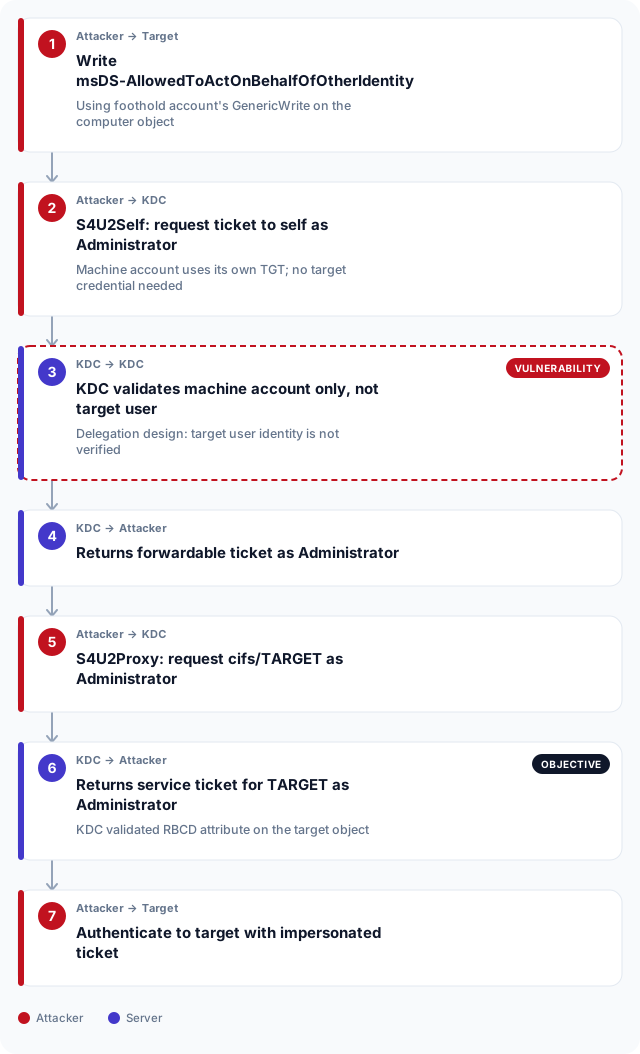
What the attack leaves in event logs
The RBCD chain writes to Active Directory before it requests any ticket, and that write is the most reliable detection point. Windows event ID 5136 is emitted every time an AD object attribute is modified; a SIEM rule filtering on attribute name msDS-AllowedToActOnBehalfOfOtherIdentity catches the write regardless of which tool performed it. The event carries the account that made the change, the target object, and the new attribute value. This is the class of signal that your SIEM should capture during an assumed breach exercise.
The S4U2Proxy exchange produces event ID 4769 at the domain controller, as it does for any Kerberos service ticket request. What distinguishes an RBCD-sourced ticket is the presence of a Transited-Services field in the ticket, which names the intermediate service account. Filtering 4769 events where Transited-Services is non-empty and the requesting account name ends in $ is a reliable heuristic for delegation abuse, though it fires on legitimate constrained delegation as well. Pairing it with a preceding 5136 on the same computer object removes the false positives.
Once the misconfiguration is found, hardening is fast. Remove the write right from any account that does not operationally need it. Setting MachineAccountQuota to 0 on the domain object removes the ability to add machine accounts without elevated rights, closing the first step for accounts that do not already control one. Placing high-value accounts in the Protected Users security group prevents them from being impersonated through any form of delegation. For organisations that want a formal demonstration against production controls, the red team engagement is the appropriate context; a targeted assumed breach test scoped to this technique specifically gives a faster answer to whether this path is open.
| Event ID | Source | What it records | Detection value |
|---|---|---|---|
| 4741 | DC Security log | Machine account created by a non-admin user | Baseline: flag machine accounts created outside provisioning processes |
| 5136 | DC Security log | Write to msDS-AllowedToActOnBehalfOfOtherIdentity | High: alert on this attribute name from any non-administrative account |
| 4769 | DC Security log | Kerberos service ticket requested with S4U delegation | Medium: filter on non-empty Transited-Services field from machine accounts |
| 4624 | Target Security log | Successful logon using the impersonated service ticket | Correlate with 5136 on the same computer object to confirm the chain |
RBCD misconfigurations in UAE Active Directory environments
Active Directory remains the dominant identity infrastructure in UAE enterprise environments, covering government entities in Abu Dhabi and commercial organisations across Dubai's free zones and mainland. The RBCD misconfiguration described in this article, accounts with write rights on computer objects, appears in almost any domain that has grown through mergers, departmental provisioning or legacy service account management without a formal AD hygiene program. No single deployment decision creates it deliberately; it accumulates over time.
Several UAE regulatory frameworks require security testing, and this misconfiguration falls within their scope. The UAE Information Assurance Regulation, published by TDRA and applicable federally, requires organisations to identify and remediate privilege escalation paths in their directory services. CBUAE guidance for financial institutions operating in Abu Dhabi and Dubai includes requirements for access control testing and privileged access management. An assumed breach exercise scoped to Active Directory privilege escalation addresses those requirements directly, because it starts from the realistic position of a compromised insider account rather than testing whether the perimeter can be breached.
DESC governs Dubai government entities and their direct suppliers. Its technical security standard requires periodic access rights reviews, which should include a review of write rights on computer objects in Active Directory. For organisations subject to DESC, documenting an assumed breach test that surfaces and remediates an RBCD path provides evidence of that review in a form that is specific, reproducible and verifiable.
The findings from an assumed breach test of this kind carry more weight with an internal audit or external regulator than a vulnerability scan, because they demonstrate the actual distance from a compromised account to domain admin rather than reporting a configuration flag. That distance is what a risk assessment needs to measure.
Frequently asked questions
What is resource-based constrained delegation in Active Directory?
Resource-based constrained delegation is a Kerberos delegation model introduced in Windows Server 2012 where the target machine, rather than the calling service, controls which accounts may delegate to it. The permission is stored in the msDS-AllowedToActOnBehalfOfOtherIdentity attribute on the target computer object. Any account with write access to that object can configure it, enabling an impersonated Kerberos service ticket without a domain administrator making any change.
How does RBCD abuse differ from classic Kerberos constrained delegation abuse?
Classic constrained delegation requires a domain administrator to configure the Service-For-User-To-Proxy right on the calling service account before an attacker can use it. RBCD delegation is configured by writing to the target object, so an attacker needs only write access to any computer object, which is a far more common right. RBCD also does not require the intermediate service ticket to be forwardable in all configurations, lowering the bar for a successful impersonation.
What Active Directory rights are needed to abuse RBCD?
The attacker needs write access to the target computer object: GenericWrite, GenericAll, WriteDACL or WriteOwner all qualify. WriteDACL and WriteOwner require an extra step to elevate to a full write right, but they are functionally equivalent. The attacker also needs a machine account to impersonate from; in most domains, MachineAccountQuota allows ordinary users to create machine accounts without additional privilege.
Why does RBCD abuse not require the target user's password?
The S4U2Self exchange lets a machine account request a Kerberos ticket on behalf of any user based solely on the machine account's own ticket-granting ticket. The KDC validates that the machine account is listed in the target service's RBCD attribute and issues the impersonated ticket. The target user's credential is never involved. This is the design of the Kerberos delegation mechanism, not a software defect.
What is the best way to detect RBCD abuse in a SIEM?
Windows event ID 5136 records every write to Active Directory attributes, including msDS-AllowedToActOnBehalfOfOtherIdentity. A SIEM rule alerting on that attribute name in a 5136 event from any non-administrative account is the most reliable detection, because it fires on the configuration step regardless of which tool is used. Correlating it with a subsequent 4769 event showing a non-empty Transited-Services field from a machine account confirms the second phase.
What prevents RBCD abuse once it is discovered?
Remove the write right from any account that does not operationally need it, then audit all principals in the domain holding GenericWrite, GenericAll, WriteDACL or WriteOwner on computer objects. Setting MachineAccountQuota to 0 removes the ability to create machine accounts without elevated rights. Placing high-value accounts in the Protected Users security group prevents them from being impersonated through delegation regardless of how the RBCD attribute is set.
Does RBCD abuse require a specific Windows Server version on the target?
Resource-based constrained delegation requires Windows Server 2012 or later on the target machine, and the domain functional level must be at least Windows Server 2012. Targets running Server 2008 or earlier cannot use the attribute. In practice, most live enterprise domains meet this requirement.
What is MachineAccountQuota and why does it matter for RBCD abuse?
MachineAccountQuota is a domain-level attribute that controls how many machine accounts an ordinary authenticated user may add to the domain. The default value is 10. Because RBCD abuse requires a machine account as the source of the impersonation request, an attacker who can create one under this quota does not need an existing machine account context or any elevated right to begin the attack.
What does an assumed breach test reveal about RBCD risk that a vulnerability scan cannot?
A vulnerability scan reports configuration flags: it can note that MachineAccountQuota is non-zero or that a computer object has permissive ACLs. An assumed breach test demonstrates the actual distance from a compromised low-privilege account to domain admin, using those configurations in a real chain. That distance is what a risk assessment needs, and what a regulator or auditor asking for evidence of access control testing is looking for.