Key takeaways
- A purple team delivers detection rules your team wrote and owns, not a report of gaps.
- Settle the technique list and your SIEM coverage before requesting proposals.
- A qualified proposal names each technique, maps it to MITRE ATT&CK, and states who does the detection work.
- Compare proposals on technique count, detection deliverable format and whether a retest slot is included.
- Confirm detection rule ownership and the retest process in the contract before the session begins.
What a purple team engagement actually delivers
A purple team engagement is a joint, controlled session where an offensive operator executes techniques from an agreed list while your detection team responds in real time. Neither side is hidden from the other. The red side announces each technique before running it, the blue side works in its production detection tooling, and the output is detection rules your team wrote during the session. Those rules belong to you at the end: not a report of gaps, but working content in your SIEM.
That separates it from a red team engagement, where the blue side operates blind and the measure is whether the attacker was caught. If your question is 'do our detections fire against this technique?', a purple team answers it. If your question is 'can we catch an attacker we do not know is there?', a red team is the right instrument. Know which question you are asking before requesting proposals.
Scope questions to settle before you request proposals
A purple team proposal cannot be priced accurately without three inputs: your detection platform (the SIEM and any EDR or NDR feeding it), your blue team's availability for the session day, and the range of techniques you want to test. Without these, vendors quote against assumed conditions and the delivered scope will differ from what was priced. Send them with the initial request for proposals, not after a shortlist has formed.
The technique list is worth settling before proposals go out. A session covering 40 techniques in a day will run each for about fifteen minutes. A session covering 10 techniques has space to run, fail, tune and re-run each one until the detection actually works. Building the technique list is a process tied to your threat profile and your current SIEM coverage. A vendor who proposes a technique list without knowing either has not read your environment.
What a qualified proposal contains
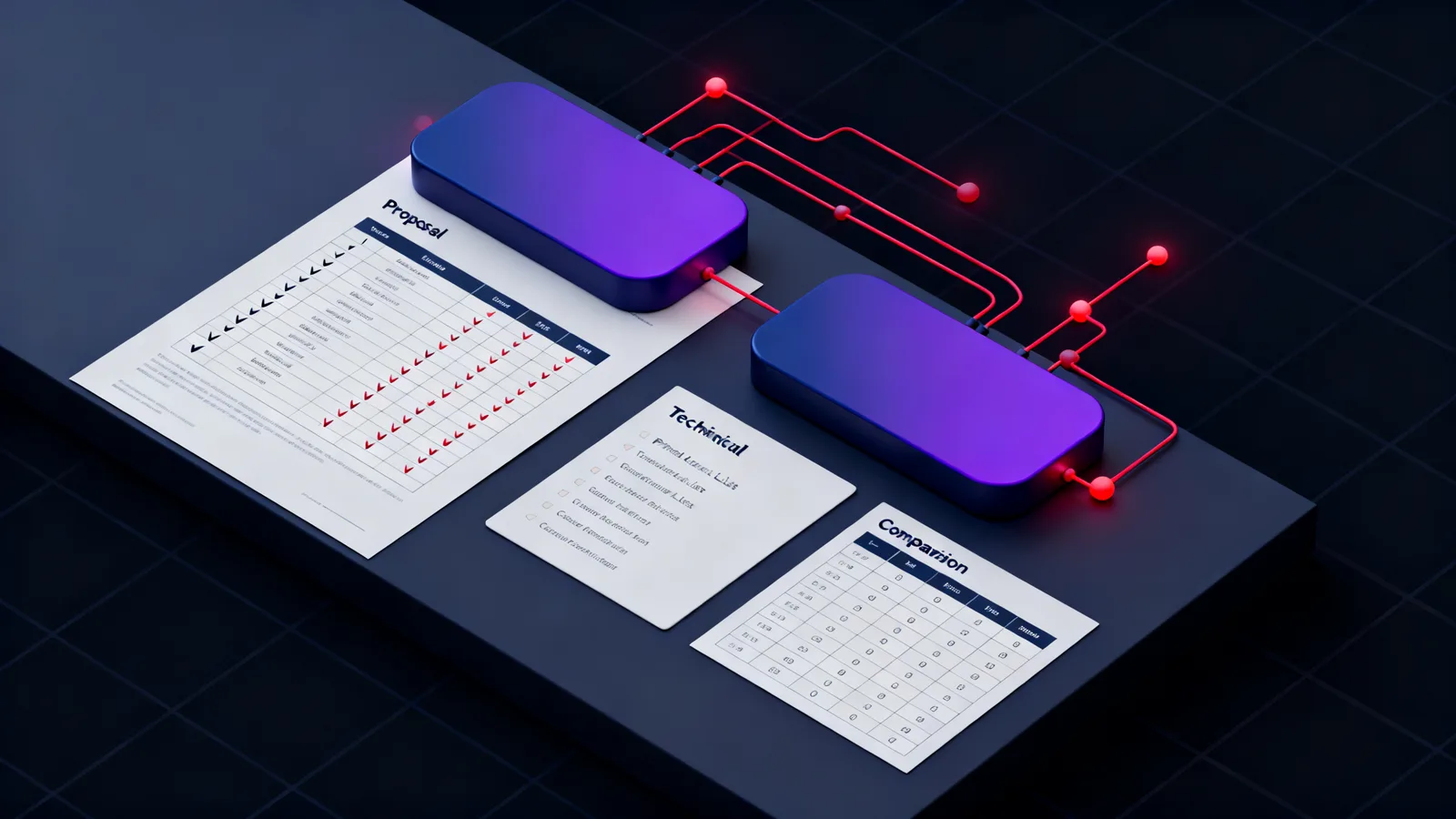
A qualified proposal names the technique list explicitly and maps each technique to a tactic in MITRE ATT&CK. It states who does the detection work: your team, the vendor's team, or a joint effort where your analysts write the rules while the operator runs the technique. It describes what the vendor hands over at the end: detection rules, tuning notes, a session record. A proposal that describes collaborative testing without naming any of these is not a purple team proposal.
The proposal should also state the platform requirements. Some vendors write Sigma rules that your team translates into native queries; others write directly in your platform's query language but only support a small set of them. The distinction matters: a Sigma rule is portable, but translation adds work and a converted rule can miss field names or query syntax specific to your platform. How a purple team session runs, hour by hour describes what the operational cadence looks like in practice, and what your team needs to bring on the day.
Technique list with ATT&CK mapping
Named techniques, not a capability statement
Platform and tooling requirements
SIEM, EDR, NDR support stated explicitly
Detection deliverable format
Sigma, native queries, or both
Retest slot and ownership transfer
Verification that the written rules fire
How to compare proposals
When you have two or more proposals in hand, compare them against the same criteria rather than reading each in isolation. Set the criteria before you read the proposals: a vendor who scored well on a criterion you added after reading their submission has shaped your evaluation. Price is a valid criterion, but it should sit beside technique count, detection deliverable format, platform support and retest process rather than replace them. The table below names the criteria that separate a strong proposal from an adequate one.
What the table does not capture is whether you are buying the right exercise at all. The comparison in purple team or Red Team: which exercise answers your question lays out the decision. If your objective is testing existing controls rather than writing new ones, an assumed breach exercise is a different instrument: it tests post-compromise detection against a granted foothold rather than writing new rules.
| Criterion | Strong proposal | Weak proposal |
|---|---|---|
| Technique list | Built from your threat profile and SIEM coverage | Generic list, same for every client |
| Platform support | Native queries in your SIEM or Sigma plus translation | Sigma only, translation left to your team |
| Detection ownership | Rules verified by retest before the engagement closes | Rules handed over without verification |
| Team involvement | Your analysts write detections during the session | Vendor writes, your team observes |
| Retest slot | Included in scope, with dates agreed upfront | Available at additional cost or not offered |
Matching the engagement to your detection maturity
The right engagement format depends on two factors: how much of your environment is covered by detection logging, and how available your blue team is for the session day. A team with broad logging but analysts who cannot commit a full day needs a different scope from a team that has both. Neither rules out a purple team exercise. The format should fit your actual situation.
A team with partial logging coverage should address the gaps before the session, or scope the session narrowly to the systems that are covered. An adversary simulation tests a threat-intelligence-led attack scenario rather than building your detection capability, and suits a different objective. The matrix below maps the four common situations and the engagement format that fits each.
Detection logging depth
Structured workshop
5 to 15 techniques, guided detection writing
Full purple team
Broad coverage, analyst-led rule creation
Build logging first
Partial logging gaps need closing first
Targeted gap session
Partial logging, narrow scope, high team skill
Blue team availability
What to agree before you sign
Two things are worth settling in the contract before the session begins. First, who owns the detection rules: some vendors retain the IP and license the output back to you; in others you own everything written during the session. A detection rule your team cannot modify is a rule your team cannot maintain, and a rule your team does not understand is one they cannot tune when it starts generating false positives. Second, what the engagement closes on: a session that ends on the session day without verifying that the written rules fire against the technique is delivering a hypothesis, not a control.
Detection decay should be in the contract too. Rules that fire correctly on session day can stop working when your environment changes: a new log source format, a software update, a changed authentication path. Detection decay: keeping purple team rules working after the session covers what happens to purple team output over the following months. The NIST SP 800-115 testing guidance covers retesting as part of security assessments; the same expectation applies to purple team detections.
Purple team engagements and UAE regulatory requirements
The UAE has four regulatory regimes that name security testing as a control requirement: the Central Bank of the UAE for financial institutions, the Dubai Electronic Security Center for Dubai government entities and their direct suppliers, the Abu Dhabi Healthcare Information and Cyber Security standard (ADHICS) for healthcare entities in Abu Dhabi, and the Information Assurance Standard published by the National Electronic Security Authority for federal systems. None of these prescribes a purple team exercise by name. CBUAE and the UAE IAS both require evidence that detective controls are tested against known attack patterns, and a purple team session produces that evidence in a form regulators can read: a technique list mapped to ATT&CK, session notes, and verified detection rules with dates and responsible parties.
Dubai entities under DESC scope and Abu Dhabi entities subject to ADHICS can cite purple team session records as evidence that detective controls were tested against the techniques relevant to their threat profile. Free-zone entities and mainland organisations without a direct regulatory mandate benefit from the same output: not a compliance document but working detection rules, written in your platform, against the techniques your environment is most exposed to. A session record naming the techniques run, the analyst responsible and the detection status serves as an audit artefact for any framework that asks for evidence of detective control testing.
Frequently asked questions
What is a purple team engagement?
A purple team engagement is a joint, structured session where an offensive operator executes techniques from an agreed list while your detection team responds in real time. The goal is not to find gaps and report them but to build detection rules against each technique during the session. Those rules are tested, verified and handed to your team at the end.
How does a purple team engagement differ from a red team?
In a red team engagement, the blue side operates blind: the measure is whether the attacker was caught. In a purple team, neither side is hidden from the other. The red side announces each technique before running it, and the blue side writes detection rules against it in real time. One tests your detection capability as it stands; the other builds it.
What SIEM or detection platform do I need before running a purple team?
You need a SIEM or EDR that is receiving logs from the systems in scope. The session cannot build a detection rule against a technique if the system where the technique runs is not sending logs. You do not need an existing detection library. What you need is confirmed log coverage for the in-scope systems.
How many techniques should a purple team session cover?
The number depends on the time available and the depth you want. A session covering 5 to 15 techniques has space to run, fail, tune and re-run each one until the detection works. A session covering more than 30 techniques in a single day can only give each one about fifteen minutes, which is too short to write and verify a detection. Start narrow and go deep rather than broad and shallow.
Who writes the detection rules during a purple team session?
In most formats, your analysts write the rules while the operator runs the technique. The vendor's role is to execute the technique repeatedly and accurately while your team works on the detection. Some vendors write the initial rule and have your team tune it. Both approaches work. Either way, the goal is that your team understands and owns the rule at the end.
What should a purple team proposal include?
A qualified proposal names the technique list, maps each technique to a MITRE ATT&CK tactic, states who does the detection work, describes the deliverable format (Sigma rules, native platform queries or both), and names the retest process. Without these specifics, the proposal cannot be compared against another on equal terms.
How does a purple team differ from an adversary simulation?
A purple team builds detection rules against specific techniques, with the blue team as an active participant. An adversary simulation tests a threat-intelligence-led attack scenario against your controls, with the blue team as the subject. Purple teaming answers whether you can detect a technique; adversary simulation answers whether a realistic adversary can reach a named objective.
What does a purple team engagement cost?
Cost depends on the number of techniques, the session duration, the platform your team uses and whether the vendor writes rules in your native query language or in Sigma. Request itemised proposals that break out the technique list, the session day and the retest slot separately; that lets you compare vendors on the same basis.
What does the detection output look like after a purple team session?
The output is a set of tested detection rules, one per technique, written in your SIEM or EDR's query language or in Sigma for translation. Each rule is verified against the technique on session day before the session closes. You should also receive a session record showing which techniques were run, which produced a detection, and which did not, with the reason in each case.
How do I know if my organisation is ready for a purple team engagement?
You are ready if the systems in scope are sending logs to your SIEM or EDR and your blue team can commit analysts to the session. You do not need an existing detection library. What you do need is confirmed log coverage, a blue team that can be in the room, and an agreed technique list. If log coverage is partial, scope the session to the covered systems and address the gaps before expanding.